
The commute this morning resembled the real commute. 288 was a parking lot all the way back to Robious Road – traffic choked on both sides. I opted for the scenic route, adding 15 minutes but saving my sanity. Sometimes, slowing down to slow down is exactly what you need. And with where I’m at with work right now, that’s the lesson I’m taking to heart today. Driving near Charlottesville, the cedars against the Virginia mountain backdrop… spectacular.
I remember the day I discovered Harry Murray. Our local Fran Betters. I grew up picking Fran’s brain who was our local legend during my youth, so I had no problem calling Harry’s shop. Though I’ve never met him in person, he’s been an invaluable resource for this New York transplant navigating Virginia waters. I told him I was coming from Richmond, craving pocket water. Without hesitation, he recommended several options within a manageable drive.
I’m ashamed to admit that despite hiking there numerous times, even with my wife, I’d never really fished here. In nearly twenty years. Harry’s first recommendation, and today, I finally cast a fly.
The literature says to cross the river three times before the good water starts. Knowing the history of the flood that nearly destroyed the river 30 years ago, I was eager to see what nature’s healing powers had wrought.
Following a white Subaru to the parking lot (the same car my friend Will drives…was this a surprise visit?!), I secretly hoped he’d join me. Though I love solo walkabouts, sharing these “little boy” adventures with friends is special too.
A group of hiking women confirmed the “three crossings” secret, making me think I should start fishing sooner. 😂
The hike felt easier this month. January was tough. Longer, colder, overall it was extremely difficult but rewarding. I had to tighten my vest pack’s waist belt – progress!
The trail’s steepness often mirrors the river’s grade, indicating prime trout lies. I think anglers often avoid these stretches – too dangerous, not their “style.” I love the rough stuff. I’ve learned to appreciate the pockets others overlook. (Thanks for that slab you pulled out of the spot I just walked past, Dave.)
As the trail eases, the river comes into view, but that’s not always where the fish are. The accessible spots – perfect for family picnics – are often barren. A good lesson for young anglers: easy access rarely yields the same satisfaction as hard-earned rewards. Quick wins might satisfy a shallow urge, but they don’t run deep.
Case in point: a small, well-worn path bypassing a section of trail. Saved maybe ten seconds, but a dead giveaway. Time to move on. Though, it was a perfectly acceptable spot to stretch the fly line and assess the water. (See? Positive thinking!)
After the second crossing, I found signs of another angler. No hat, bright colors. Maybe they didn’t care, maybe they were on a quick lunch break escape. I left them the next stretch – fun, shallow, perfect for a beginner. Made some assumptions, and moved on.
Ahead, I found the water I was looking for: steeper gradients, white water punching into short pockets, undercut banks – prime trout habitat. Dry fly anglers are drawn to the beautiful, not always the productive. Tough lesson, because nothing beats a topwater take. Explosive, thrilling, two worlds colliding, with an audio bonus. Plus, the ripple effect.
These days, though, the sound of the line snapping off the water to set the hook is equally rewarding. I trust my instincts. I no longer need to see it to believe it.
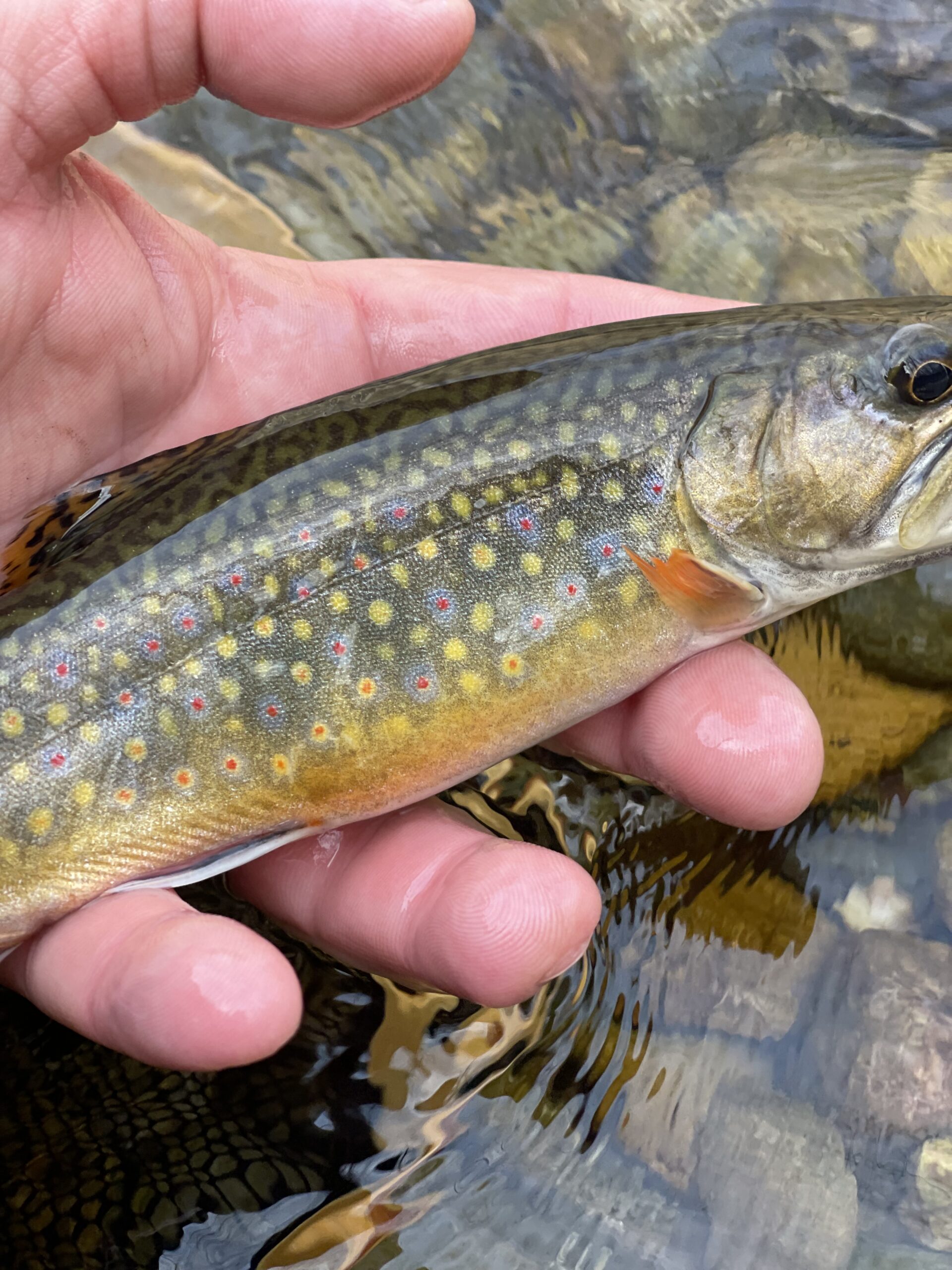
First good-looking hole, first cast: a beautiful, fat trout. Second cast, he slashed at my March Brown, but it wasn’t what he wanted. Switched to a Golden Parachute. Next hole up, a few casts later: an even bigger, more beautiful trout. Landed, admired, released. The next section held several more. Two chased dries, so I tied on a Christmas Caddis emerger. A few more slashes, but no hookups.
For a while, nothing. Great-looking water, but no signs of life. Switched flies, nymphs and dries, nothing doing.
Around 11:30, above the next flat section, the action started. The deep slots and gradients held the most active fish. The flat water, while attractive to anglers (Fran Betters’ “sweetwater fishermen”), was lifeless. I prefer the plunge pools and riffles, where trout magically materialize from the dark depths. They blend in so well, it’s like they fold in from another dimension when they hit your fly.
Discovered my spare spool case was open, nymph line gone. Hoping it’s back at the car. Quickly cracked a Genesee Cream Ale, thinking of my God Father Stan and our Mohawk Mills Park adventures, hunting “crabs” (crayfish). Took a minute to enjoy the sounds of the water and regroup.
The afternoon bite slowed on the Golden Parachute. Experimented, several refusals, then scaled down to a smaller Sparkle Dun variant. Game on. They sipped that fly like it was the real deal, rising from the bottom to inhale it with no hesitation. Several large fish for that size river – even I was surprised how eager they were. Two trout even rose to the same fly, twice.
I noticed that the holding lies shifted in the afternoon, from the tails of runs to the throughout the runs and deeper midsections. Several trout in thin water rolled and missed the fly. Oh well.
Hiking out, I realized what a great summer swimming hole this would be. Time to bring the family.
At the final crossing, I carefully avoided a tiny brook trout fry. A good sign the population is recovering from the devastating floods of the 90s.